
ESD PTFE
Electrostatic Dissipative / Conductive PTFE
The chemical inertness and non-stick properties of PTFE — modified with carbon to provide ESD-safe performance in aggressive process environments.
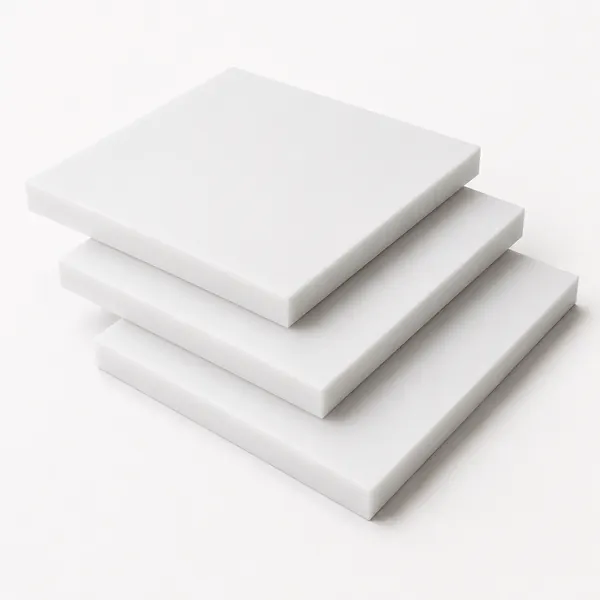
Overview
ESD PTFE is a carbon-filled polytetrafluoroethylene (PTFE) compound that provides electrostatic dissipative or conductive properties while retaining the broad chemical inertness, non-stick surface, and temperature resistance that make PTFE unique. Standard PTFE is an insulating material — charge can accumulate on PTFE surfaces in chemical process equipment or semiconductor wet benches, creating a static discharge risk. ESD PTFE addresses this by incorporating conductive carbon filler while preserving as much of PTFE's chemical resistance as possible. It is used in semiconductor wet processing, chemical distribution systems, and handling equipment where both chemical inertness and static control are simultaneously required.
Working properties
-
Chemical resistance
ESD PTFE retains a very broad chemical resistance comparable to standard PTFE. It resists most acids, bases, solvents, and aggressive process chemicals used in semiconductor wet processing and chemical handling — a key reason for its selection over other ESD plastics in chemically demanding environments.
-
Static dissipative or conductive behaviour
The carbon filler provides a path for charge dissipation. The specific resistivity range should be confirmed for your ESD classification. Note that higher carbon loading can slightly affect chemical resistance compared with virgin PTFE.
-
Non-stick surface
ESD PTFE retains the low surface energy and non-stick properties of PTFE. This is useful in chemical process equipment where material build-up on surfaces is a concern.
-
Temperature resistance
ESD PTFE maintains its properties across a wide temperature range, from cryogenic to elevated temperatures well above most engineering thermoplastics. Confirm specific grade limits for your operating conditions.
-
Softness and creep
Like standard PTFE, ESD PTFE is relatively soft and prone to creep (cold flow) under sustained mechanical load. It should not be used in applications requiring high dimensional stability under pressure without appropriate design consideration.
Typical uses
- Semiconductor wet bench components — trays, carriers, and guides in aggressive chemical environments
- Chemical process equipment where both ESD control and broad chemical resistance are required
- ESD-safe liner material in chemical storage and distribution
- Precision chemical handling fixtures in cleanroom environments
Things to confirm before ordering
- Resistivity class — confirm required resistivity range; ESD PTFE grades vary in resistivity depending on carbon content.
- Chemical exposure — confirm the specific chemicals and temperatures; carbon filler can slightly reduce chemical resistance vs virgin PTFE for specific aggressive media.
- Load conditions — ESD PTFE creeps under sustained load; confirm that the design accommodates this.
- Colour — ESD PTFE is typically black or dark grey due to carbon loading; it is not available in the white of virgin PTFE.
How does ESD PTFE compare?
-
PVDF (ESD or standard) →
PVDF is structurally stiffer and holds dimensional tolerances better than PTFE. For most semiconductor chemical distribution components, PVDF is preferred when structural integrity is needed. ESD PTFE is chosen when PTFE's unique chemical resistance (particularly to certain aggressive acids) is required.
-
ESD POM →
ESD POM is dimensionally more precise and lower cost but cannot match ESD PTFE's chemical resistance. ESD POM is appropriate for mechanical/structural ESD components; ESD PTFE for chemically demanding environments.
Properties on this page are indicative only — exact mechanical, thermal, and chemical values vary by grade, filler, and manufacturer. Always verify suitability for your specific application before ordering. Need a certified grade? (FDA, UL94, food-grade, medical-grade, ISO) — ask us via WhatsApp and we will advise on what is available.