
ESD MC Nylon
Electrostatic Dissipative Cast Nylon (PA6)
Large-section nylon with static-dissipative properties — for bushings, wear pads, and structural components in ESD-critical environments.
Overview
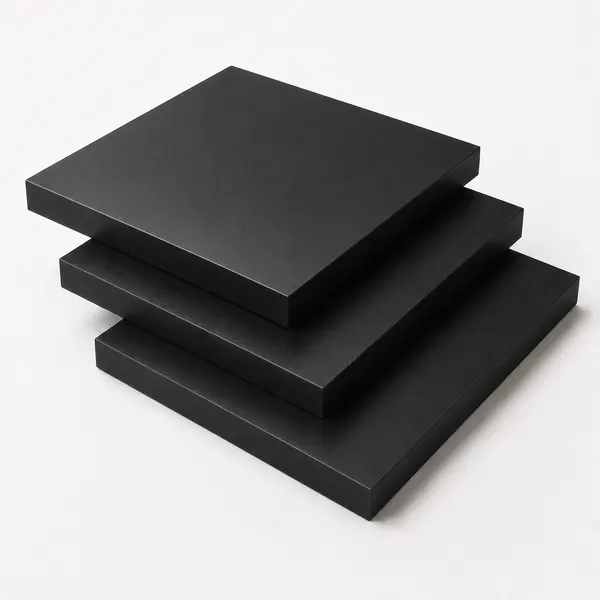
ESD MC Nylon is a cast polyamide 6 (PA6) modified with carbon or conductive fillers to provide static-dissipative or conductive properties. Cast nylon's key advantage over extruded grades is that it can be produced in very large diameter rods (up to 500 mm and beyond), very thick sheets, and near-net-shape blocks, making it appropriate for large bushings, wear pads, and structural components where no other ESD-grade plastic would be available in the required section. It retains the general mechanical character of MC Nylon — reasonable strength, toughness, and wear resistance — while providing a controlled static-dissipative path.
Working properties
-
Large section availability
The defining advantage of ESD MC Nylon is availability in very large rod diameters and thick sections not achievable with extruded engineering plastics. This makes it the only practical ESD-grade plastic option for large bushings, structural pads, and thick wear components.
-
Static dissipative properties
The conductive filler system provides a path for static charge dissipation. The resulting resistivity should be confirmed against your specific ESD zone classification and application.
-
Moisture absorption consideration
Nylon absorbs moisture from the environment, which causes slight dimensional change. This is more significant in large sections and must be accounted for in tight-tolerance applications. Allow time for the material to reach dimensional equilibrium in the service environment before final machining where tolerances are critical.
-
Wear resistance
ESD MC Nylon has useful wear resistance for sliding contact and bushing applications, though lower than ESD UHMW. It is appropriate for moderate-duty wear components in ESD-controlled environments.
-
Machinability
ESD MC Nylon machines well on standard CNC equipment. Sharp tooling and appropriate cooling help achieve good surface finishes. Large diameter rods can be turned down to finished bushing dimensions.
Typical uses
- Large bushings, wear pads, and bearings in semiconductor and electronics handling equipment
- Structural components and mounting blocks in ESD-controlled automated systems
- Guide blocks and wear liners in large automated assembly equipment
- ESD-safe jig and fixture bodies requiring larger section sizes
Things to confirm before ordering
- Section size — confirm the required rod diameter or sheet thickness; the main reason to specify ESD MC Nylon is when large sections are needed.
- Resistivity class — confirm the required resistivity range for your application.
- Moisture allowance — for tight-tolerance machined parts, confirm whether pre-conditioning is needed and whether final machining after equilibration is planned.
- Colour — typically black due to conductive filler.
How does ESD MC Nylon compare?
-
ESD POM →
ESD POM machines to tighter tolerances, has lower moisture absorption, and is more dimensionally stable. Use ESD POM for precision small-to-medium components; ESD MC Nylon for large sections unavailable in POM.
-
Standard MC Nylon →
Standard MC Nylon is an electrical insulator. In ESD-controlled environments, the insulating property is a risk — ESD MC Nylon is required wherever static charge accumulation is a concern.
Properties on this page are indicative only — exact mechanical, thermal, and chemical values vary by grade, filler, and manufacturer. Always verify suitability for your specific application before ordering. Need a certified grade? (FDA, UL94, food-grade, medical-grade, ISO) — ask us via WhatsApp and we will advise on what is available.