
Nylon
Polyamide (PA6 / PA66 / MC Nylon)
A strong, tough engineering plastic with excellent wear resistance and self-lubricating properties for gears, bushings, and structural components.
Overview
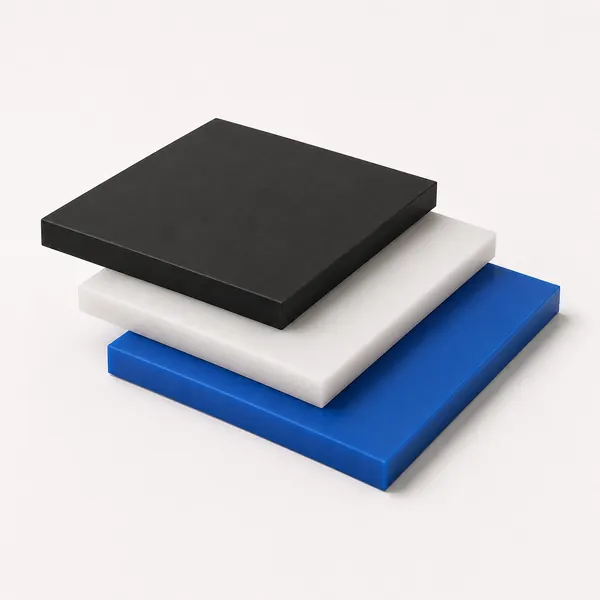
Nylon (Polyamide) is one of the most widely used engineering thermoplastics for machined mechanical components. It combines high mechanical strength, good fatigue resistance, and a low friction surface that performs well in sliding contact against metals — particularly when oil or grease is present. Three main grades are relevant in engineering stock form: PA6 (commonly available in large cast sections and a range of sizes), PA66 (slightly stiffer and higher melting point, better for elevated-temperature applications), and MC Nylon (monomer-cast in very large sections, cost-effective for large machined billets, available in oil-filled grade for improved bearing performance). A key property to manage is moisture absorption — nylon absorbs moisture from the environment, which causes measurable dimensional changes. This must be accounted for in precision-tolerance applications. Advance Supplies carries PA6, PA66, and MC Nylon in sheet, rod, and tube.
Working properties
-
Mechanical strength
Nylon offers high tensile, flexural, and compressive strength relative to its cost and ease of machining. It is a practical choice for structural mechanical components — gears, rollers, pulleys, and load-bearing pads — where strength and toughness are both required.
-
Wear resistance and self-lubrication
Nylon has a naturally low friction surface against metals and performs well in sliding and rotating contact applications. Oil-filled grades (particularly oil-filled MC Nylon) have lubricant distributed throughout the material, extending wear life significantly in bearing and bushing applications without external grease.
-
Moisture absorption
Nylon absorbs moisture from the surrounding environment — the amount depends on humidity and immersion conditions. This causes dimensional changes (swelling) and a reduction in stiffness and strength. For precision components with tight tolerances, parts should be machined after conditioning to their operating environment, or acetal should be considered as an alternative.
-
Temperature performance
Nylon retains useful mechanical properties at moderately elevated temperatures — PA66 somewhat better than PA6. Both grades are used in under-bonnet and machinery environments where moderate heat is present, subject to confirming the specific service temperature against the grade's rated limit.
-
Chemical resistance
Nylon resists oils, greases, fuels, and many alkalis well. It is not suitable for strong acids (including dilute hydrochloric and sulphuric acid) or strong oxidising agents, which cause surface degradation. Evaluate chemical exposure carefully for process equipment applications.
-
PA6 vs PA66 vs MC Nylon
PA6 is most commonly available in a wide size range and is the standard choice for general machined components. PA66 is stiffer and has a higher melting point — preferred where elevated temperature or stiffness requirements push PA6 to its limits. MC Nylon is cast in large billets and is cost-effective for large sections; oil-filled MC Nylon is a popular bearing material.
Typical uses
- Gears, sprockets, and rack-and-pinion components
- Bushings, bearings, thrust washers, and guide rollers
- Pulleys, wheels, and conveyor rollers
- Structural wear pads and slide plates
- Sheaves and cable management components
- Machined mechanical parts requiring strength and toughness
Things to confirm before ordering
- Grade — PA6, PA66, or MC Nylon: confirm based on section size, temperature requirements, and whether oil-filled grade is needed for bearing applications.
- Oil-filled vs standard — oil-filled MC Nylon significantly extends bearing life in sliding contact; confirm if your application is a bushing or bearing surface.
- Section size — MC Nylon is available in larger billet sizes than extruded PA6/PA66; for large machined components, confirm the maximum available section.
- Moisture consideration — for precision-tolerance parts, discuss conditioning and whether acetal (lower moisture absorption) may be a better fit.
- Colour — natural (off-white/cream) is standard; black is also available in some grades.
How does Nylon compare?
-
Acetal / POM →
Acetal has much lower moisture absorption than nylon, making it better for precision-tolerance parts in humid or wet environments. Nylon has higher strength and toughness and is better for heavy-duty mechanical components. Both are used for gears and bushings — the choice depends on the moisture exposure and load profile.
-
UHMW-PE →
UHMW-PE has better abrasion resistance and no moisture absorption, but lower strength and stiffness than nylon. UHMW is preferred for low-load sliding wear liners; nylon is better for structural mechanical components under higher stress.
-
PEEK →
PEEK extends nylon's performance at elevated temperatures and in aggressive chemical environments. Significant cost premium. Choose PEEK when nylon has reached its temperature or chemical resistance limits.
Properties on this page are indicative only — exact mechanical, thermal, and chemical values vary by grade, filler, and manufacturer. Always verify suitability for your specific application before ordering. Need a certified grade? (FDA, UL94, food-grade, medical-grade, ISO) — ask us via WhatsApp and we will advise on what is available.