
Vespel (Polyimide)
Polyimide Engineering Plastic
An ultra-high-temperature polyimide for the most demanding aerospace, semiconductor, and precision bearing applications — where no other plastic suffices.
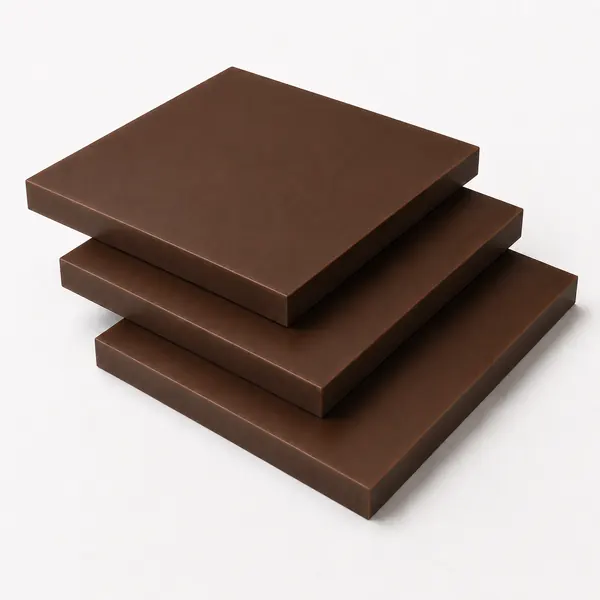
Overview
Vespel is DuPont's trade name for a family of sintered polyimide (PI) plastics that represent the upper limit of engineering thermoplastic performance. Unlike most thermoplastics, Vespel is not melt-processed — it is compression-sintered, more like a ceramic manufacturing process than conventional injection moulding. This gives it an extremely high continuous service temperature, far exceeding PEEK or Ultem, and the ability to operate in vacuum, cryogenic conditions, and radiation environments where other polymers would fail. Vespel is used in the most demanding applications in aerospace, semiconductor, cryogenics, and scientific instrumentation where no other plastic provides adequate performance. It commands an extremely high price — components are typically machined from Vespel rod or preformed shapes.
Working properties
-
Extreme continuous service temperature
Vespel can be used at continuous temperatures far beyond any other engineering thermoplastic. It does not melt — it degrades rather than flowing when overheated. This makes it one of the only plastic materials suitable for applications near jet engine hot sections, re-entry vehicles, and high-temperature furnace components in non-oxidising atmospheres.
-
Cryogenic performance
Vespel retains mechanical properties and flexibility down to liquid helium temperatures. This is unusual — most plastics embrittle badly at cryogenic temperatures. Vespel is used in cryogenic valve seals, superconducting magnet components, and scientific instrument components at liquid nitrogen and liquid helium temperatures.
-
Vacuum and outgassing
Vespel has very low outgassing rates — it does not release significant amounts of volatile compounds under vacuum. This is essential for space, semiconductor, and high-vacuum applications where outgassing from materials contaminates process environments or optical surfaces.
-
Wear and bearing properties
Unfilled Vespel (SP-1) has inherently good wear resistance. Graphite-filled grades (SP-21) and MoS₂-filled grades (SP-22) further improve dry-running bearing performance. Vespel bearings are used in aircraft engine bearings, spacecraft mechanisms, and semiconductor handling arms operating at temperatures where no other bearing material works.
-
Radiation resistance
Vespel retains mechanical properties after significant radiation exposure — an important consideration for nuclear, medical, and scientific applications where other polymers quickly degrade.
-
Cost
Vespel is among the most expensive engineering plastics available. It is chosen only when its unique combination of extreme temperature, cryogenic, vacuum, and radiation performance is genuinely required. For less extreme applications, PEEK or Ultem are far more economical.
Typical uses
- Jet engine bushings, thrust washers, and seals in hot-section areas
- Spacecraft and satellite mechanisms requiring performance from cryogenic to elevated temperatures
- Semiconductor wafer handling arms and end-effectors exposed to process temperatures
- Cryogenic valve seals and structural components in liquid nitrogen/helium systems
- High-vacuum components in particle accelerators and scientific instruments
- Nuclear reactor and radiation-environment structural components
Things to confirm before ordering
- Grade — Vespel SP-1 (unfilled), SP-21 (graphite-filled, bearing grade), SP-22 (MoS₂-filled), and other grades serve different applications; provide full application details.
- Operating conditions — temperature range (both maximum and minimum), load, speed, and environment (vacuum, radiation, chemical); these determine which grade is appropriate.
- Lead time and minimum quantity — Vespel is not a stocked commodity; supply lead times and minimum quantities typically apply. Enquire early in the design process.
How does Vespel (Polyimide) compare?
-
PEEK →
PEEK has a significantly lower maximum service temperature than Vespel but is far more economical, easier to machine, and available in a wider range of standard sizes. For the majority of high-temperature engineering applications, PEEK is the appropriate first choice; Vespel is for the extreme cases where PEEK is not adequate.
-
Ultem (PEI) →
Ultem is below PEEK in maximum service temperature and well below Vespel. It is much more economical and appropriate for the large majority of elevated-temperature applications. Vespel is reserved for genuinely extreme conditions.
Properties on this page are indicative only — exact mechanical, thermal, and chemical values vary by grade, filler, and manufacturer. Always verify suitability for your specific application before ordering. Need a certified grade? (FDA, UL94, food-grade, medical-grade, ISO) — ask us via WhatsApp and we will advise on what is available.