
PEEK
Polyether Ether Ketone
A high-performance semi-crystalline thermoplastic known for its resistance to elevated temperatures, aggressive chemicals, and mechanical fatigue.
Overview
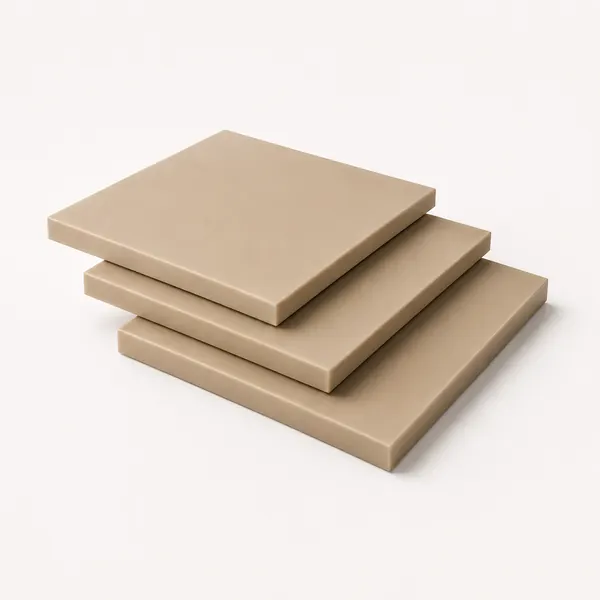
PEEK (Polyether Ether Ketone) is a semi-crystalline thermoplastic that holds its properties across a broad range of operating conditions — elevated temperatures, chemical exposure, and repeated mechanical loading. It is typically chosen when standard engineering plastics such as Nylon, Acetal, or Polycarbonate have reached their performance limits. PEEK is available in unfilled, glass-fibre-filled, and carbon-fibre-filled grades, each with different stiffness, strength, and friction characteristics. Advance Supplies carries PEEK in sheet, rod, and tube form and can supply cut-to-size or in full standard lengths.
Working properties
-
Temperature resistance
PEEK retains its mechanical properties at elevated continuous service temperatures where most commodity and semi-engineering plastics begin to soften or lose strength. Short-term excursion temperatures are higher still — confirm the specific grade limits with us before designing to a temperature boundary.
-
Chemical resistance
PEEK resists a broad range of acids, bases, and organic solvents that would attack most engineering thermoplastics. Concentrated sulphuric acid and some halogenated solvents are exceptions — always verify compatibility with a chemical resistance table for your specific media before use.
-
Mechanical strength
Unfilled PEEK is stiffer and stronger than most thermoplastics at equivalent temperatures. Glass-fibre-filled (GF) grades increase flexural modulus and reduce thermal expansion; carbon-fibre-filled (CF) grades add further stiffness and improved tribological performance. Grade choice should match your load and thermal requirements.
-
Wear and friction
Unfilled PEEK performs well under sliding contact in many applications. PTFE- and graphite-filled bearing grades offer lower friction coefficients and improved dry-running wear life for bushings, thrust washers, and bearing surfaces. Bearing grade selection depends on load, speed, and lubrication conditions.
-
Machinability
PEEK machines cleanly on conventional CNC equipment with carbide or HSS tooling. Sharp cutting edges, moderate spindle speeds, and adequate chip evacuation are recommended. The material holds close tolerances well after machining when cooled gradually — rapid cooling can introduce residual stress in thick sections.
-
Dimensional stability
PEEK has low moisture absorption compared to most nylons and polyamides, giving it good dimensional stability in humid environments. Thermal expansion is lower than many other thermoplastics, which is relevant for precision components operating across a temperature range.
Typical uses
- Pump components — impellers, wear rings, and valve seats in chemical process equipment
- Semiconductor and wafer handling fixtures where chemical resistance is critical
- High-load bearing bushings, thrust washers, and guide strips
- Aerospace and precision instrument structural parts requiring low weight and high strength
- High-temperature electrical insulation components
- Structural parts in sterilisation or autoclave environments (confirm suitability for your specific cycle conditions)
Things to confirm before ordering
- Grade — unfilled, glass-filled (GF30), carbon-filled (CF30), or bearing-grade: each has different stiffness, friction, and thermal expansion characteristics.
- Colour — natural PEEK is off-white or tan; carbon-filled grades are typically black. Confirm if colour matters for your application.
- Form and size — specify sheet thickness, rod diameter, or tube OD and ID; we will confirm the closest available standard size.
- Certifications — if your process requires traceable material certifications (heat cert, test report), request this at the time of enquiry.
- Quantity and lead time — common grades and sizes are generally available from stock; less common grades or sizes may require a lead time. Confirm before committing to a delivery schedule.
How does PEEK compare?
-
Ultem (PEI) →
Amorphous, slightly lower maximum continuous use temperature than PEEK, but typically lower cost. Suitable where full PEEK performance is not required. Also has good inherent flame resistance.
-
PPS (Tectron) →
Good chemical resistance and inherent flame resistance at a lower cost point than PEEK. Brittle in unfilled form; glass-filled grades improve toughness. Consider PPS where cost is a driver and PEEK thermal performance is not needed.
-
PVDF (Kynar) →
Outstanding chemical inertness and UV resistance, particularly in halogen and strong oxidising acid environments where PEEK may not be appropriate. Lower maximum use temperature than PEEK.
Properties on this page are indicative only — exact mechanical, thermal, and chemical values vary by grade, filler, and manufacturer. Always verify suitability for your specific application before ordering. Need a certified grade? (FDA, UL94, food-grade, medical-grade, ISO) — ask us via WhatsApp and we will advise on what is available.