
PVC
Polyvinyl Chloride (uPVC)
A rigid, chemically resistant thermoplastic widely used for chemical tanks, ducting, pipe systems, and structural fabrication.
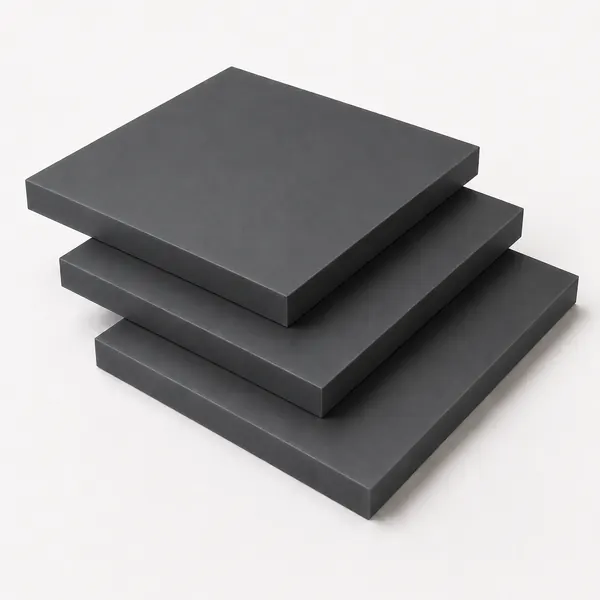
Overview
Rigid PVC (uPVC — unplasticised) is one of the most widely used engineering thermoplastics for chemical handling, fluid systems, and structural fabrication. It offers good resistance to a broad range of acids, alkalis, and aqueous solutions, is inherently self-extinguishing, and machines and welds readily. It is available in grey, white, and clear grades and in a range of sheet thicknesses, rods, and tubes. Rigid PVC is not suitable for high-temperature applications or contact with many organic solvents. For higher service temperatures, CPVC is the standard upgrade. Advance Supplies carries rigid PVC sheet, rod, and tube.
Working properties
-
Chemical resistance
Rigid PVC resists a broad range of inorganic acids, alkalis, salts, and aqueous solutions — making it a practical and cost-effective choice for chemical tanks, plating equipment, and laboratory fixtures. It is not resistant to many organic solvents (acetone, MEK, THF, chlorinated solvents), which attack and dissolve the material.
-
Flame behaviour
PVC is inherently self-extinguishing — it does not sustain combustion once the ignition source is removed. This is an inherent property of the base material (chlorine content) and does not require additives, though it should not be relied on in place of proper fire safety engineering.
-
Rigidity and service temperature
Rigid PVC is stiff and dimensionally stable at ambient temperatures. Its maximum continuous service temperature is lower than many engineering plastics — it begins to soften and lose load-bearing capacity at moderate elevated temperatures. It is not suitable for hot-water systems or elevated-temperature chemical processes; CPVC or PP are better alternatives in those cases.
-
Machinability and weldability
PVC saws, drills, and machines cleanly with standard equipment. It can be hot-gas welded using PVC filler rod, making it well suited for fabricating tanks, vessels, and ducting with sealed joints. Solvent cement bonding is also widely used for pipe systems.
-
Weatherability
Rigid PVC has moderate outdoor performance. Prolonged UV exposure and heat cycling cause gradual surface degradation and colour change. For long-term outdoor structural use, consider UV-stabilised grades or protective coatings.
Typical uses
- Chemical storage tanks and processing vessels
- Electroplating and surface treatment equipment
- Ducting, pipe systems, and fume extraction channels
- Laboratory fixtures, trays, and acid-resistant surfaces
- Structural fabrication — brackets, guards, housing panels
- Signage backing panels and light-duty structural components
Things to confirm before ordering
- Grade and colour — grey (standard engineering), white, or clear; confirm which suits your fabrication or chemical environment.
- Form — sheet, rod, or tube; confirm dimensions and whether cut-to-size is needed.
- Chemical contact — verify compatibility with your specific chemicals before use; organic solvents will attack PVC.
- Temperature requirement — if your application involves temperatures above ambient, confirm the service temperature; CPVC may be needed.
- Welding requirement — if you need welded joints, confirm we have matching PVC welding rod in the appropriate grade and colour.
How does PVC compare?
-
CPVC →
CPVC (chlorinated PVC) handles higher continuous service temperatures than rigid PVC, making it the standard choice for hot chemical service. Higher cost than PVC.
-
Polypropylene (PP) →
PP offers better resistance to organic solvents and is lighter than PVC. Good alternative for chemical tanks where solvent resistance is needed. PP is less rigid than PVC and not self-extinguishing in standard grades.
-
HDPE →
HDPE is tougher and has excellent chemical resistance, particularly to concentrated acids and bleach solutions. Less rigid than PVC but better for applications requiring impact resistance.
Properties on this page are indicative only — exact mechanical, thermal, and chemical values vary by grade, filler, and manufacturer. Always verify suitability for your specific application before ordering. Need a certified grade? (FDA, UL94, food-grade, medical-grade, ISO) — ask us via WhatsApp and we will advise on what is available.