
PTFE
Polytetrafluoroethylene (PTFE) — Teflon
The most chemically inert engineering plastic available, with the lowest friction coefficient of any solid material and a very wide service temperature range.
Overview
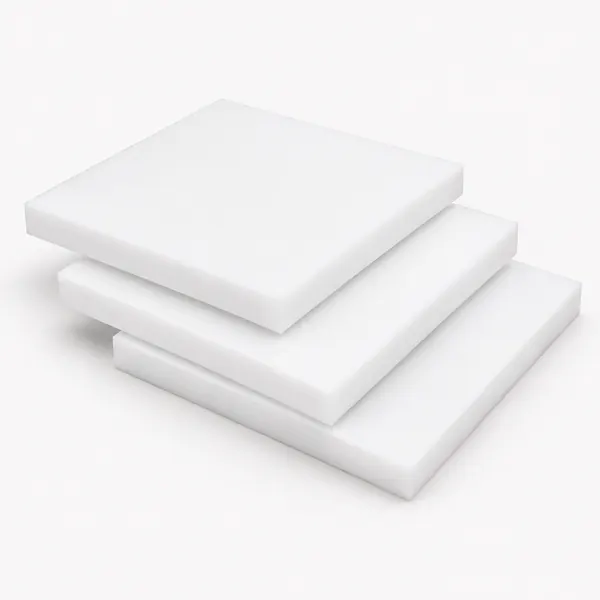
PTFE (Polytetrafluoroethylene) — widely known under the DuPont trade name Teflon — is unique among engineering plastics for its near-universal chemical resistance, extremely low friction surface, and broad temperature capability. It resists virtually all chemical media, including concentrated acids, strong alkalis, and aggressive organic solvents, with only a handful of exceptions (molten alkali metals and elemental fluorine under certain conditions). Unlike most thermoplastics, PTFE cannot be injection moulded or conventionally extruded — it is processed by compression sintering and machined from the resulting billets, rod, and sheet. This process-limited production means PTFE stock is more expensive than most commodity engineering plastics. A key design consideration is PTFE's tendency to cold-flow (creep) under sustained compressive load — virgin PTFE deforms significantly under load, and filled grades are almost always specified for load-bearing applications. Advance Supplies carries virgin PTFE and filled grades in sheet, rod, and tube.
Working properties
-
Chemical inertness
PTFE resists virtually all chemical media — concentrated acids, strong alkalis, halogens, and aggressive organic solvents that would attack most other plastics. It is the first-choice material for gaskets, valve seats, and seals in aggressive chemical service where no other plastic is suitable.
-
Friction coefficient
PTFE has the lowest coefficient of friction of any known solid material. This makes it effective in dry-running sliding and bearing applications, and means it has an inherently non-stick surface — useful in applications where material build-up or adhesion is a problem.
-
Temperature range
PTFE performs across a very wide temperature range — from cryogenic temperatures to well above what most engineering thermoplastics can sustain. It retains useful properties at both extremes without becoming brittle at low temperatures or losing significant properties at high continuous service temperatures.
-
Creep and cold flow
Virgin PTFE deforms permanently under sustained compressive load (cold flow) — a significant limitation in gasket and valve seat applications. Designs must account for this by limiting compressive stress or using retaining features. Filled grades (glass-filled, carbon-filled, bronze-filled) substantially reduce cold flow and improve creep resistance.
-
Filled grades
Glass-filled PTFE improves creep resistance and wear life while maintaining good chemical resistance. Carbon-filled PTFE improves electrical conductivity (ESD) and has good wear properties. Bronze-filled PTFE improves thermal conductivity and bearing performance against steel. The trade-off in all filled grades is reduced chemical inertness compared to virgin PTFE.
-
Electrical insulation
Virgin PTFE is an outstanding electrical insulator with stable dielectric properties across a wide frequency range and temperature range. It is used for high-frequency electrical insulation, coaxial cable insulation, and electrical standoffs in demanding environments.
Typical uses
- Chemical seals, gaskets, and valve seats in aggressive chemical service
- Piston seals, rod seals, and lip seals in hydraulic and pneumatic systems
- Bearing pads, slide plates, and low-friction guide surfaces
- Electrical insulation in high-frequency, high-temperature environments
- Laboratory equipment exposed to aggressive reagents
- Expansion joint liners and pipe flange gaskets in chemical plants
Things to confirm before ordering
- Grade — virgin or filled (glass, carbon, bronze): virgin for maximum chemical resistance; filled grades for load-bearing, wear, or bearing applications.
- Filler type — confirm which filler suits your application: glass for general creep reduction; carbon for electrical or ESD; bronze for high-load bearing faces.
- Section and thickness — PTFE is produced by sintering and may not be available in all sizes; confirm the section you need.
- Chemical contact — confirm even with PTFE; very few exceptions exist but high-pressure fluorine gas and molten alkali metals are incompatible.
- Load conditions — if PTFE is under compressive load, discuss the design to manage cold flow; a retaining groove or housing is usually needed.
How does PTFE compare?
-
PFA
PFA (Perfluoroalkoxy) has similar chemical resistance to PTFE and can be melt-processed (extruded, moulded), which allows more complex shapes. Higher cost than PTFE. Choose PFA where PTFE's processing limitations prevent the required form.
-
PVDF (Kynar) →
PVDF is stiffer and has better creep resistance than PTFE, with good but not equivalent chemical resistance. PVDF can be conventionally processed. Use PVDF where structural strength or dimensional stability under load is needed alongside chemical resistance.
-
UHMW-PE →
UHMW-PE has better wear resistance and lower cost than PTFE in bearing applications. PTFE has lower friction and far superior chemical resistance. For low-load, dry-running seals in aggressive chemicals, PTFE is the appropriate choice; for heavy abrasion wear liners, UHMW-PE is typically more cost-effective.
Properties on this page are indicative only — exact mechanical, thermal, and chemical values vary by grade, filler, and manufacturer. Always verify suitability for your specific application before ordering. Need a certified grade? (FDA, UL94, food-grade, medical-grade, ISO) — ask us via WhatsApp and we will advise on what is available.