
PU (Polyurethane)
Polyurethane Elastomer
A tough, abrasion-resistant elastomer that outperforms rubber in wear applications — used for wheels, liners, and impact protection.
Overview
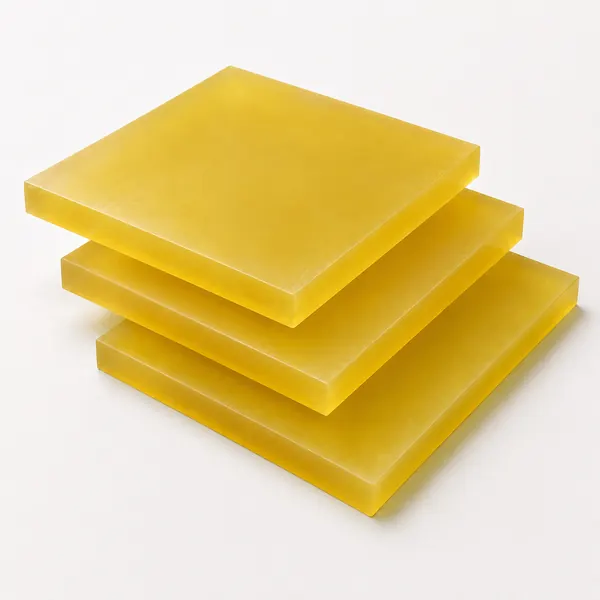
Polyurethane (PU) elastomer occupies a unique position between rigid plastics and conventional rubbers. It can be formulated across a very wide hardness range — from soft, gel-like materials to semi-rigid solids — and consistently delivers higher abrasion resistance than most natural and synthetic rubbers. PU is also notable for its resistance to cuts, tears, and impact damage. It is used in wheels, rollers, conveyor belts, lining plates, bumpers, and wear pads where rubber would wear out too quickly. PU is not a single material but a broad family; properties vary significantly by formulation, hardness, and manufacturing method.
Working properties
-
Abrasion resistance
PU elastomers have outstanding abrasion resistance — significantly better than most rubber grades and comparable to engineering thermoplastics in wear-intensive applications. This is the primary reason PU is specified for lining plates, screen decks, wheels, and conveyor belt covers subject to abrasive wear.
-
Hardness range
PU can be formulated from very soft (Shore A 20) to semi-rigid (Shore D 70+). The appropriate hardness depends on the application — softer grades for vibration absorption and flexible sealing; harder grades for structural load-bearing and wear surfaces.
-
Tear and cut resistance
PU has significantly better tear and cut resistance than most rubbers at equivalent hardness. This extends component life in applications where sharp or angular abrasive particles are present.
-
Chemical resistance
PU is resistant to oils, greases, fuels, and aliphatic hydrocarbons, making it useful in hydraulic and lubrication system seals and components. It is susceptible to attack by hot water, steam, strong acids, alkalis, and many polar solvents — confirm compatibility for your specific environment.
-
Temperature limitations
PU is not suitable for high-temperature service — it softens and loses mechanical properties at relatively modest temperatures compared with engineering plastics. For elevated-temperature or steam applications, other rubber grades are more appropriate.
-
Hydrolysis susceptibility
PU can degrade through hydrolysis (reaction with water) over extended periods, particularly in warm, humid, or wet service. Not all PU formulations are equally susceptible — hydrolysis-resistant grades are available for wet environments.
Typical uses
- Abrasion-resistant lining plates for hoppers, chutes, and cyclones
- Industrial wheels and rollers on trolleys, conveyors, and handling equipment
- Conveyor belt covers and impact bars
- Hydraulic and pneumatic seals and scrapers
- Bumpers, pads, and shock-absorbing mounts
- Screen deck panels and wear surfaces in mineral processing
Things to confirm before ordering
- Hardness — specify the required Shore A or Shore D hardness for the application; this is the single biggest determinant of mechanical behaviour.
- Chemical exposure — confirm the specific fluids, cleaning agents, and environmental conditions the part will contact.
- Temperature — confirm service temperature range; PU is not suitable for continuous elevated-temperature service.
- Wet or submerged service — confirm if hydrolysis-resistant grade is needed for permanently wet applications.
- Form — PU is available as sheet for cutting to profile or as moulded components; confirm which is appropriate.
How does PU (Polyurethane) compare?
-
Natural Rubber (NR) →
Natural rubber has excellent dynamic properties (resilience, fatigue resistance) but lower abrasion resistance than PU. NR is better for dynamic sealing and vibration damping; PU is better for wear resistance.
-
NBR (Nitrile Rubber) →
NBR is specifically better in oil and fuel contact at elevated temperatures. PU handles oils but may not match NBR in all high-temperature oil environments.
Properties on this page are indicative only — exact mechanical, thermal, and chemical values vary by grade, filler, and manufacturer. Always verify suitability for your specific application before ordering. Need a certified grade? (FDA, UL94, food-grade, medical-grade, ISO) — ask us via WhatsApp and we will advise on what is available.