
Polypropylene
Polypropylene (PP)
A lightweight, chemically resistant thermoplastic with broad resistance to acids, alkalis, and many organic solvents.
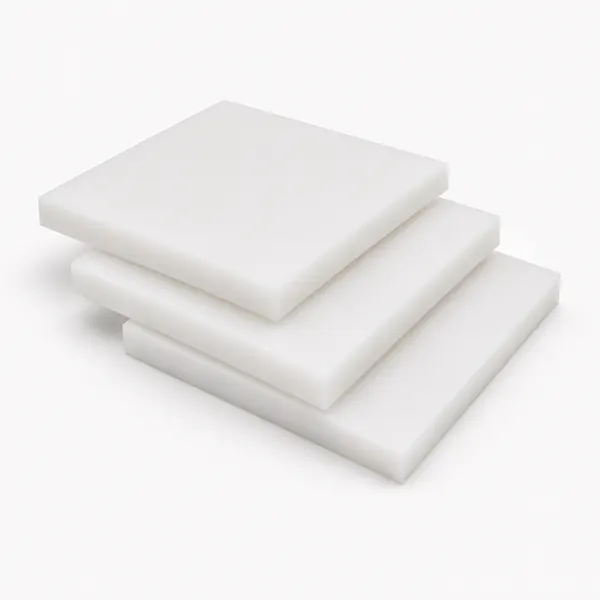
Overview
Polypropylene (PP) is a semi-crystalline thermoplastic notable for its low density, excellent chemical resistance — particularly to organic solvents and acids — and good fatigue resistance. It is one of the lightest engineering plastics (it floats in water) and is widely used in chemical processing, food handling equipment (confirm grade requirements), and general fabrication where resistance to a broad chemical range is needed. Two main grades are available: homopolymer (stiffer, higher strength) and copolymer (better impact resistance, especially at lower temperatures). PP has limited UV stability in natural grade; carbon-black-filled or UV-stabilised grades are used for outdoor applications. Advance Supplies carries PP sheet, rod, and tube.
Working properties
-
Chemical resistance
PP resists a very broad range of chemicals — including most acids, alkalis, alcohols, and many organic solvents — better than PVC or HDPE in several chemical categories. This makes it a first choice for chemical tanks, process vessels, and pipework where a wide variety of media may be present.
-
Lightweight
PP has one of the lowest densities of any engineering plastic — lower than water. This is useful where weight is a concern in structural applications or where equipment must be moved or handled regularly.
-
Fatigue resistance
PP has good resistance to repeated flexing without cracking — the well-known "living hinge" effect. While relevant primarily to moulded parts, this property also means PP fabricated components tolerate vibration and cyclic loading reasonably well.
-
Service temperature
PP maintains its structure at moderately elevated temperatures — higher than PVC but not as high as PVDF or CPVC for chemical service. Under sustained load at elevated temperatures, creep must be considered in the design.
-
Homopolymer vs copolymer
Homopolymer PP is stiffer and stronger at room temperature. Copolymer PP (random or impact copolymer) has improved impact resistance, particularly at lower temperatures, and is often preferred for applications involving temperature variation or impact risk.
-
UV and weathering
Natural PP grades degrade under prolonged UV exposure — it becomes brittle over time. For outdoor applications, specify carbon-black-filled (black) or UV-stabilised grade. Black PP sheet is commonly used in outdoor chemical storage and construction applications.
Typical uses
- Chemical process tanks, vessels, and trays
- Acid and alkali handling equipment and splash guards
- Food processing equipment components (confirm grade and application)
- Battery cases and electrochemical process equipment
- Laboratory trays, sinks, and work surfaces
- Lightweight structural panels and housing components
Things to confirm before ordering
- Homopolymer or copolymer — homopolymer for stiffness and strength; copolymer for better impact, especially at lower temperatures.
- Colour — natural (translucent white) is standard; grey and black (UV-stabilised) are also available. Confirm for outdoor use.
- Chemical contact — PP resists most chemicals but has limitations; verify compatibility with your specific media.
- Temperature requirement — confirm the continuous service temperature and whether the application involves sustained load at elevated temperatures.
- Form and dimensions — sheet, rod, or tube; confirm standard sizes available and whether cut-to-size is needed.
How does Polypropylene compare?
-
PVC (Rigid) →
PVC is stiffer and self-extinguishing but has poorer organic solvent resistance than PP. Choose PP where broader chemical compatibility is needed. Choose PVC where rigidity and flame behaviour are priorities.
-
HDPE →
HDPE is tougher and has excellent impact resistance. PP is lighter and generally has better chemical resistance across a wider range. For chemical tanks, PP is often preferred; for impact-critical or wear applications, HDPE may be better.
-
PVDF (Kynar) →
PVDF handles much higher service temperatures and has superior chemical resistance for aggressive media. Significant cost premium over PP. Choose PVDF when PP has reached its temperature or chemical limits.
Properties on this page are indicative only — exact mechanical, thermal, and chemical values vary by grade, filler, and manufacturer. Always verify suitability for your specific application before ordering. Need a certified grade? (FDA, UL94, food-grade, medical-grade, ISO) — ask us via WhatsApp and we will advise on what is available.