
G10 / FR4 (Glass Epoxy)
Glass-fabric Epoxy Laminate
A woven glass-fibre epoxy laminate with excellent electrical insulation, moisture resistance, and dimensional stability.
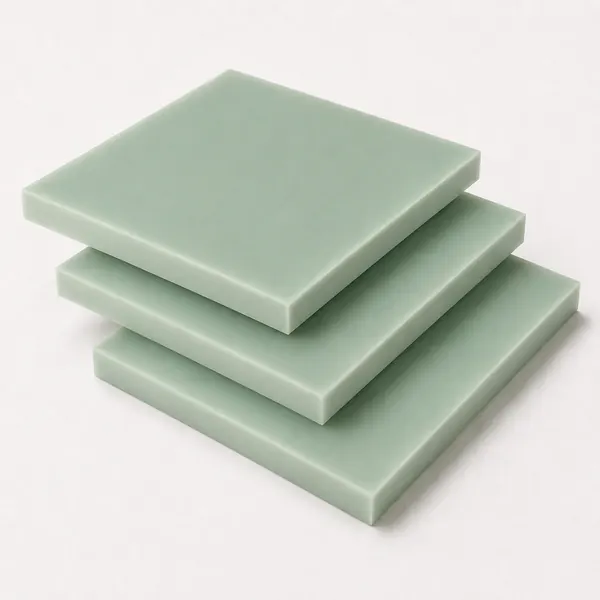
Overview
G10 and FR4 are grades of glass-fabric reinforced epoxy laminate. G10 is the base grade; FR4 is a flame-retardant version of G10 — the difference is the addition of flame retardant chemistry in the epoxy resin. FR4 is the most widely used grade in the electronics industry as the substrate material for printed circuit boards (PCBs), but both G10 and FR4 sheet are also supplied as engineering materials for structural insulating components, electrical panel work, and precision machined parts. Both offer excellent electrical insulation, low moisture absorption, good mechanical strength, and dimensional stability — properties that make them superior to paper-base phenolic for demanding electrical insulation applications.
Working properties
-
Electrical insulation
G10/FR4 provides excellent dielectric properties across a range of frequencies and temperatures. It has low dielectric loss and high dielectric strength, making it suitable for high-frequency and high-voltage insulating applications beyond the capability of paper-base phenolics.
-
Moisture resistance
G10/FR4 has very low moisture absorption compared with paper-base phenolic and fabric-base Tufnol. This makes it appropriate for humid and wet environments where phenolic grades would be unsuitable. Electrical properties are better retained in varying humidity conditions.
-
Mechanical strength and stiffness
The glass-woven reinforcement gives G10/FR4 high tensile and flexural strength with good stiffness. It is appropriate for structural insulating panels, bus bar separators, and load-bearing insulating components.
-
Dimensional stability
G10/FR4 is highly dimensionally stable with low thermal expansion. This is important for precision insulating components and panel work where dimensional consistency under varying temperatures is required.
-
Machinability
G10/FR4 machines by sawing, drilling, and routing but the glass fibre content makes it highly abrasive — it wears tooling rapidly and produces fine glass-dust particles requiring respiratory protection. Carbide tooling is recommended.
-
Flame retardancy (FR4)
FR4 includes flame-retardant chemistry that resists ignition and self-extinguishes. This is required by many electrical panel and enclosure standards. G10 is the non-FR-rated version for applications where flame rating is not specified.
Typical uses
- Electrical switchgear and panel insulation — bus bar separators, mounting plates, and standoffs
- High-frequency and high-voltage insulating components
- Precision machined insulating parts requiring good moisture resistance
- Printed circuit board substrate (FR4) in electronics manufacturing
- Cryogenic and low-temperature structural insulating components (G10 is used in cryogenic applications)
Things to confirm before ordering
- G10 or FR4 — FR4 is required where a flame-retardant rating is specified; G10 is non-FR. Most panel and electrical applications in Malaysia specify FR4.
- Thickness — confirm the required sheet thickness; standard thicknesses range from thin PCB grades to thick structural panels.
- Electrical parameters — for high-voltage or high-frequency applications, confirm specific dielectric strength and loss requirements.
How does G10 / FR4 (Glass Epoxy) compare?
-
Bakelite / Phenolic (paper base) →
Paper-base phenolic is cheaper and easier to machine but has poorer moisture resistance, lower electrical performance, and less dimensional stability. G10/FR4 is the better choice for demanding electrical insulation applications.
-
Tufnol (cotton-fabric phenolic) →
Tufnol is more machinable and has better impact toughness but lower electrical performance and moisture resistance than G10/FR4. Use G10/FR4 when electrical performance and moisture resistance are the priority.
Properties on this page are indicative only — exact mechanical, thermal, and chemical values vary by grade, filler, and manufacturer. Always verify suitability for your specific application before ordering. Need a certified grade? (FDA, UL94, food-grade, medical-grade, ISO) — ask us via WhatsApp and we will advise on what is available.