
ESD Ultem
Electrostatic Dissipative Polyetherimide
High-temperature ESD-safe performance — the precision of Ultem with static-dissipative properties for demanding semiconductor and aerospace environments.
Overview
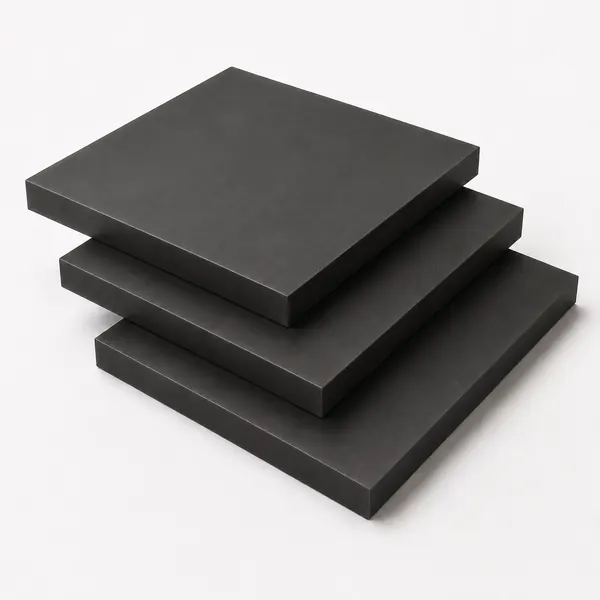
ESD Ultem is a carbon-filled or conductively modified grade of Polyetherimide (PEI) that combines the high-temperature capability and inherent flame resistance of standard Ultem with electrostatic dissipative properties. It is chosen when an application requires both elevated-temperature service and ESD control — for example, semiconductor processing fixtures that are exposed to heat during reflow or curing steps, or aerospace ESD-sensitive assembly jigs. ESD Ultem is one of the more specialised ESD materials and is typically chosen when standard ESD grades such as ESD POM or ESD UHMW cannot meet the temperature requirement.
Working properties
-
ESD performance at elevated temperature
ESD Ultem provides static-dissipative resistivity across the temperature range relevant to semiconductor processing. Unlike some conductive fillers that shift resistivity significantly with temperature, ESD Ultem grades are formulated to maintain consistent ESD performance within the service temperature range.
-
High continuous service temperature
Like standard Ultem, ESD grades retain structural integrity at elevated temperatures significantly above standard ESD materials such as ESD POM or ESD UHMW. This enables use in fixturing that passes through ovens, reflow zones, or high-temperature process steps.
-
Inherent flame resistance
ESD Ultem retains the inherent flame resistance of PEI without halogenated additives. This is relevant for aerospace and transit interior applications where both ESD control and flame resistance are specified.
-
Machinability
ESD Ultem machines to tight tolerances using standard CNC equipment. It produces good surface finishes. Sharp tooling appropriate for high-performance thermoplastics is recommended.
-
Dimensional stability
PEI has very low moisture absorption, contributing to excellent dimensional stability across varying humidity — important for precision ESD-sensitive fixtures in controlled environments.
Typical uses
- Semiconductor process fixtures exposed to elevated temperatures during reflow, bake, or cure steps
- Aerospace ESD-sensitive structural components requiring inherent flame resistance
- High-temperature ESD trays, carriers, and burn-in sockets
- Precision machined ESD components for instrumentation in temperature-varying environments
Things to confirm before ordering
- Resistivity class — confirm required surface and volume resistivity range for your ESD zone classification.
- Service temperature — confirm maximum continuous and peak temperatures; verify that ESD properties are maintained across the full temperature range.
- Grade — glass-filled ESD Ultem grades offer higher stiffness; unfilled grades are standard for most applications.
- Sterilisation compatibility — if steam sterilisation is required, confirm compatibility with the specific grade.
How does ESD Ultem compare?
-
ESD POM →
ESD POM is lower cost and appropriate for ambient to moderate temperatures. When the service temperature exceeds what ESD POM can handle, ESD Ultem is the upgrade.
-
ESD PEEK →
ESD PEEK offers a higher maximum service temperature than ESD Ultem and broader chemical resistance. ESD Ultem is the choice where Ultem's inherent flame resistance is required or where full PEEK performance is not needed.
Properties on this page are indicative only — exact mechanical, thermal, and chemical values vary by grade, filler, and manufacturer. Always verify suitability for your specific application before ordering. Need a certified grade? (FDA, UL94, food-grade, medical-grade, ISO) — ask us via WhatsApp and we will advise on what is available.