
Acrylic
Polymethyl Methacrylate (PMMA)
A rigid, optically clear thermoplastic with excellent UV resistance and a glass-like surface finish.
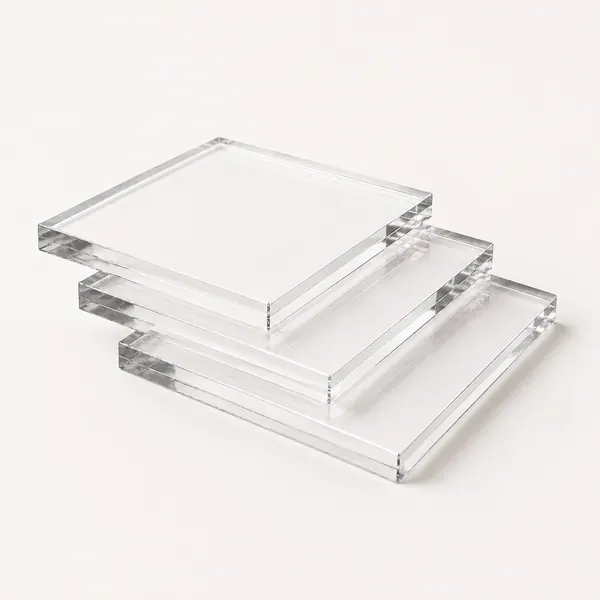
Overview
Acrylic (PMMA) is a rigid, transparent thermoplastic valued for its optical clarity, weatherability, and polishable surface. It is commonly chosen as a lighter, more workable alternative to glass in display, signage, and machine guarding applications. Two main production methods exist: cast acrylic offers better optical uniformity and surface quality; extruded acrylic is more cost-effective and consistent in thickness but has slightly different machining characteristics. Acrylic is stiffer than polycarbonate but significantly more brittle under impact. It bonds well with solvent cements and can be hot-formed into curved shapes. Advance Supplies carries acrylic sheet in clear and a range of colours.
Working properties
-
Optical clarity
Acrylic transmits light very effectively — among the highest of any rigid plastic. It produces a clearer, less tinted appearance than polycarbonate under equivalent conditions, making it a preferred choice where optical quality is important.
-
UV and weather resistance
Acrylic is inherently resistant to UV degradation and does not yellow significantly under prolonged outdoor exposure. This is a key advantage over standard (non-UV-stabilised) polycarbonate, which hazes and yellows over time without UV protection.
-
Rigidity and brittleness
Acrylic is stiffer than polycarbonate at equivalent thickness but has much lower impact resistance. It fractures rather than deforms under sudden impact — an important design consideration for machine guards and safety glazing. For high-impact applications, polycarbonate is generally the better choice.
-
Surface quality and polishability
Acrylic accepts a polished finish more readily than most engineering plastics and can be flame-polished or mechanically polished to restore optical clarity after machining. It scratches more easily than glass but can be brought back to an optical finish.
-
Machinability and thermoforming
Acrylic saws, drills, and CNC-mills cleanly. Cast grades tend to machine more smoothly than extruded grades. It can be thermoformed (hot bent, vacuum formed) at moderate temperatures without loss of transparency — useful for curved guards and displays.
-
Chemical resistance
Acrylic resists water, dilute acids, alkalis, and mineral oils. It is attacked by many organic solvents — including acetone, MEK, esters, and chlorinated solvents — which is relevant both as a limitation in chemical environments and a feature for solvent-cement bonding.
Typical uses
- Display cases, shop displays, and retail fixture glazing
- Machine guards and safety screens where optical clarity is required
- Signage panels, illuminated signs, and light diffusers
- Aquarium panels and water feature glazing
- Architecture and interior design panels and partitions
- Point-of-sale and exhibition display components
Things to confirm before ordering
- Cast or extruded — cast acrylic is preferred for optical applications and polishing; extruded is common for general fabrication.
- Colour — clear is standard; a wide range of transparent and opaque colours are available. Confirm availability for your colour.
- Thickness — confirm the required thickness; standard sheet sizes and thicknesses vary by grade and supplier.
- Surface protection — most acrylic sheet ships with a masking film; confirm whether this is included and remove it carefully before fabrication.
- UV resistance requirement — standard acrylic is UV-stable; if you need additional UV filtering (e.g. to protect exhibits or products underneath), specify UV-filtering grade.
How does Acrylic compare?
-
Polycarbonate (PC) →
PC offers far higher impact resistance and is the safer choice for machine guards where impact risk is high. Trade-off: PC yellows under UV without UV stabilisation; acrylic does not. Acrylic is also stiffer and gives better optical clarity.
-
PET / PETG →
PETG is tougher than acrylic and easier to thermoform, with good clarity. Used as a mid-point between acrylic and PC for display and forming applications where impact matters but high optical quality is less critical.
Properties on this page are indicative only — exact mechanical, thermal, and chemical values vary by grade, filler, and manufacturer. Always verify suitability for your specific application before ordering. Need a certified grade? (FDA, UL94, food-grade, medical-grade, ISO) — ask us via WhatsApp and we will advise on what is available.