
PET / PETG
Polyethylene Terephthalate / Glycol-modified PET
A tough, transparent thermoplastic that combines good chemical resistance with easy machinability.
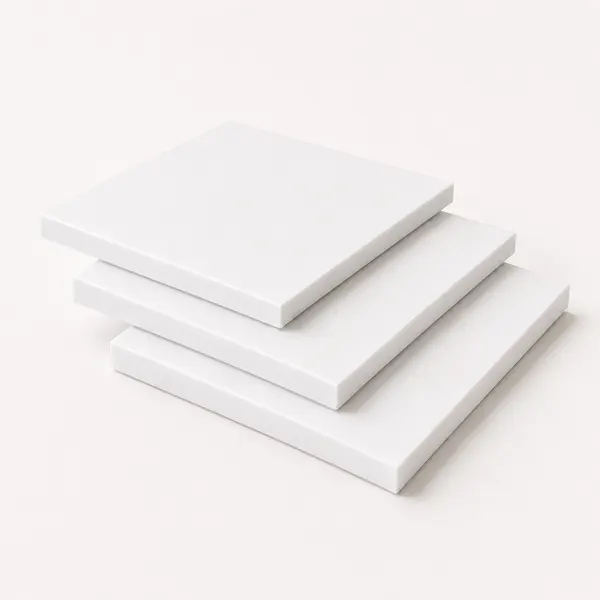
Overview
PET (Polyethylene Terephthalate) is best known as a packaging material but is also produced in sheet and rod form for general engineering use. The glycol-modified variant, PETG, is easier to machine and thermoform without requiring drying and has better clarity retention. Both offer better chemical resistance than acrylic and better scratch resistance, while remaining optically clear. PETG in particular has become popular for display and fabrication work where the brittleness of acrylic is a concern but full polycarbonate cost and weight are unnecessary.
Working properties
-
Optical clarity
PETG offers good optical transparency, comparable to acrylic for most practical purposes. It tends to retain clarity better under mild flexing or bending, where acrylic would crack.
-
Toughness vs acrylic
PETG is significantly tougher and less brittle than acrylic. It bends before breaking rather than fracturing suddenly — useful for display work, enclosures, and covers where minor impacts are a risk.
-
Chemical resistance
Both PET and PETG offer better resistance to dilute acids and alkaline solutions than acrylic. However, they are still susceptible to certain solvents and concentrated acids. Confirm chemical suitability for your specific exposure.
-
Machinability
PETG machines cleanly and produces minimal burring. It is easier to machine than standard PET and does not require pre-drying under normal workshop conditions. It responds well to laser cutting, CNC routing, and die cutting.
-
Thermoforming
PETG thermoforms at lower temperatures than acrylic and polycarbonate and produces cleaner results. It is well-suited to vacuum forming and bending for fabricated enclosures and covers.
-
UV resistance
Standard PET and PETG are not inherently UV-stable and will yellow or haze over extended outdoor exposure. For outdoor or UV-exposed applications, confirm whether a UV-stabilised grade is required.
Typical uses
- Display boxes, point-of-sale covers, and retail enclosures
- Machine guards and covers where acrylic brittleness is a concern
- Packaging trays and formed enclosures
- Thermoformed parts and vacuum-formed shells
- General fabricated panels, dividers, and partitions
Things to confirm before ordering
- PET or PETG — PETG is generally preferred for sheet and fabrication work; confirm which grade is appropriate for your process.
- Colour and clarity — clear is most common; confirm if tinted or opaque stock is available for your requirement.
- UV exposure — standard grades are not UV-stable; specify if outdoor or UV-resistant grade is needed.
- Thickness — confirm the required thickness and sheet size; availability varies by grade.
How does PET / PETG compare?
-
Acrylic (PMMA) →
Acrylic gives superior optical quality and UV stability but is considerably more brittle. PETG is the better choice where impact risk is higher or where parts will be bent or formed.
-
Polycarbonate (PC) →
PC offers far higher impact resistance and is suitable for safety glazing applications where PETG would not be appropriate. PC is also more expensive and heavier.
Properties on this page are indicative only — exact mechanical, thermal, and chemical values vary by grade, filler, and manufacturer. Always verify suitability for your specific application before ordering. Need a certified grade? (FDA, UL94, food-grade, medical-grade, ISO) — ask us via WhatsApp and we will advise on what is available.