
Acetal
Polyoxymethylene (POM) — Acetal / Delrin
A stiff, dimensionally stable engineering plastic with very low moisture absorption, excellent machinability, and consistent performance in precision components.
Overview
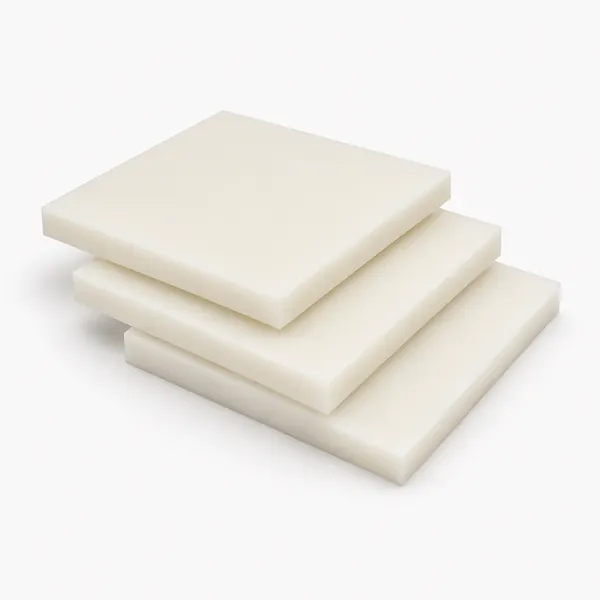
Acetal (POM — Polyoxymethylene) is one of the most widely machined engineering plastics. Its combination of high stiffness, low moisture absorption, excellent dimensional stability, and a naturally slippery surface makes it the default choice for precision machined mechanical components where tight tolerances must be maintained across varying humidity conditions. It is often preferred over nylon in applications where dimensional stability in humid environments is critical. Two grades exist: homopolymer (known commercially as Delrin — DuPont's trade name) which has higher strength and fatigue resistance, and copolymer which avoids centreline porosity in large-section rods and is preferred for thick stock. Both machine exceptionally cleanly. Advance Supplies carries acetal in sheet, rod, and tube in both homopolymer and copolymer grades.
Working properties
-
Dimensional stability
Acetal absorbs very little moisture — a key advantage over nylon. This means machined acetal parts maintain their dimensions in humid conditions and wet environments, making it the preferred choice for precision components such as valve seats, gear wheels, and sliding mechanisms where dimensional consistency is critical.
-
Machinability
Acetal is widely regarded as one of the easiest engineering plastics to machine. It produces clean chips, holds tight tolerances, and can be machined on conventional CNC equipment without specialist tooling. Cut surfaces are smooth with little burring. It is a reliable choice for high-precision machined parts.
-
Stiffness and strength
Acetal is stiffer than nylon and UHMW-PE, with high compressive strength and good resistance to creep under sustained load at ambient temperatures. This makes it suitable for components that must support sustained mechanical loads without significant deformation.
-
Self-lubrication and low friction
Acetal has a naturally low coefficient of friction against metals and against itself. It performs well in sliding contact applications without requiring external lubrication in many conditions. Wear performance is further improved with PTFE-filled grades.
-
Chemical resistance
Acetal resists oils, fuels, solvents (including many hydrocarbons), and neutral aqueous solutions. It is not suitable for use with strong acids or strong oxidising agents, which cause surface degradation. Evaluate carefully for chemical process applications.
-
Homopolymer vs copolymer
Homopolymer acetal (Delrin) has higher tensile strength and fatigue resistance. Copolymer acetal is more thermally stable and avoids the centreline porosity that can occur in large-diameter homopolymer rod — making copolymer the preferred choice for large-section stock used in thick machined components.
Typical uses
- Precision gears, gear wheels, and rack components
- Valve seats, pump impellers, and fluid handling components
- Bushings, bearings, and wear pads in humid or wet environments
- Food and beverage processing equipment components (confirm grade)
- Sliding mechanisms, guide rails, and adjustment components
- Fasteners, spacers, and precision CNC-machined parts
Things to confirm before ordering
- Homopolymer or copolymer — for thick sections (large rod diameter), copolymer is recommended to avoid centreline porosity; for thinner sections, homopolymer gives higher strength.
- Colour — natural (white) or black; both grades are available, confirm availability.
- Section size — confirm rod diameter or sheet thickness; large sections may need specific grade (copolymer) to avoid porosity.
- Chemical contact — confirm compatibility with your specific chemicals; strong acids are not suitable.
- PTFE-filled grade — if friction and wear are critical, ask about PTFE-filled acetal which offers improved sliding performance.
How does Acetal compare?
-
Nylon (PA) →
Nylon is tougher and has higher impact and tensile strength than acetal. Acetal has lower moisture absorption and better dimensional stability in wet environments. Choose acetal for precision-tolerance parts in humid conditions; choose nylon for heavy mechanical load and impact.
-
UHMW-PE →
UHMW-PE has better abrasion resistance and toughness at low temperatures, but lower stiffness and strength than acetal. Acetal is the better choice for precision machined components; UHMW-PE for heavy-duty wear liners and impact pads.
-
PEEK →
PEEK extends acetal's performance at elevated temperatures and in aggressive chemical environments. Significant cost premium. Choose PEEK when acetal has reached its temperature limits or in chemically aggressive environments.
Properties on this page are indicative only — exact mechanical, thermal, and chemical values vary by grade, filler, and manufacturer. Always verify suitability for your specific application before ordering. Need a certified grade? (FDA, UL94, food-grade, medical-grade, ISO) — ask us via WhatsApp and we will advise on what is available.