
Rulon
PTFE Composite Bearing Material (Rulon®)
A family of PTFE composite bearing materials engineered for dry-running, high-load, and chemically demanding bearing and sealing applications.
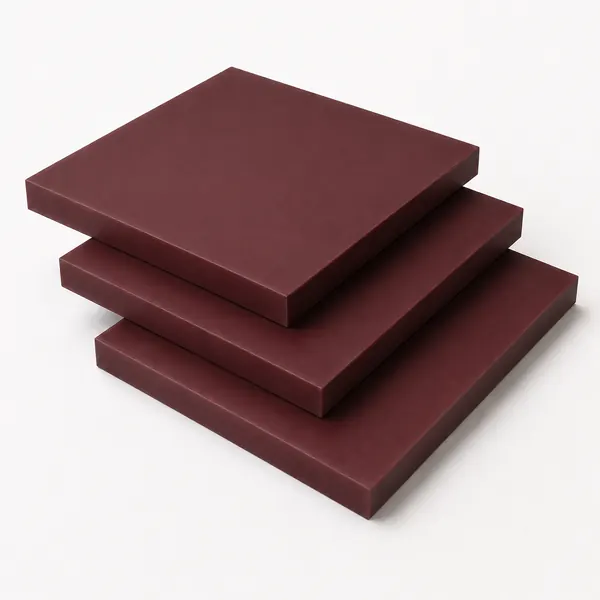
Overview
Rulon is a registered brand of Saint-Gobain Performance Plastics — a family of PTFE-based composite bearing and sealing materials, each grade compounded with different fillers (glass, carbon, bronze, mineral, or proprietary blends) to optimise performance for specific application conditions. The family spans a wide range: from soft, chemically inert grades used in pharmaceutical and corrosive environments, to hard, high-load grades for heavy industrial bearings and slideways. Unlike PTFE alone (which is soft, cold-flows under load, and cannot be used structurally), Rulon composites are reinforced to resist creep and support meaningful bearing loads while retaining PTFE's inherent lubricity and chemical inertness.
Working properties
-
Dry-running capability
All Rulon grades are designed for unlubricated or minimally lubricated bearing service. The PTFE matrix provides a self-lubricating film on the counterface, reducing friction without external lubrication — important for applications where contamination from lubricants must be avoided (food processing, semiconductor, pharmaceutical).
-
Grade selection — load vs chemical resistance trade-off
Harder, more heavily filled grades (e.g. Rulon 641) handle high PV (pressure × velocity) conditions and heavy loads. Softer, less-filled grades (e.g. Rulon J or LR) have better chemical inertness and are used in corrosive or high-purity environments. Grade selection is critical — enquire with full application details.
-
Chemical resistance
The PTFE base gives Rulon broad chemical resistance across most grades. Specific grades are used in corrosive chemical, pharmaceutical, and semiconductor environments where most other bearing materials would be attacked.
-
Conformability
Rulon grades (particularly softer grades) can conform to minor misalignments and surface imperfections in the mating counterface, distributing load more evenly and reducing edge loading — a useful characteristic in bearings where perfect alignment is not guaranteed.
-
Temperature range
Rulon can operate across a wide temperature range, including cryogenic temperatures where most elastomeric seals fail, and elevated temperatures above what most engineering thermoplastics can sustain.
Typical uses
- Bearings and bushings in food processing, packaging, and pharmaceutical equipment — dry running required
- Semiconductor and cleanroom handling equipment bearings and slides
- Machine tool slideway lining (similar application to Turcite)
- Reciprocating and rotating seals in pumps and compressors
- Aircraft control surface bearings and structural bushings
- Chemical process equipment bearings in corrosive environments
Things to confirm before ordering
- Grade — there are many Rulon grades; provide your application details (load, speed, temperature, chemical exposure, and whether dry running or minimal lubrication) so the appropriate grade can be confirmed.
- Form — sheet for machining custom parts, tape for applying to existing slideways, rod for turning bushings.
- Counterface material — Rulon performance depends on the mating surface; hardened steel, stainless, and anodised aluminium are common counterfaces. Soft counterfaces may transfer Rulon material onto them (which is normal and beneficial).
How does Rulon compare?
-
Turcite →
Turcite is primarily a slideway material for machine tools. Rulon covers a broader range of bearing and sealing applications and is available in many more grades. For machine tool slideways specifically, Turcite-B is the conventional choice.
-
Delrin AF (PTFE-filled Acetal) →
Delrin AF is an acetal-based material — stiffer and more dimensionally precise than Rulon, but not as chemically resistant or as suitable for heavy PV conditions. Delrin AF is the choice for machined precision components; Rulon for demanding bearing and seal applications.
Properties on this page are indicative only — exact mechanical, thermal, and chemical values vary by grade, filler, and manufacturer. Always verify suitability for your specific application before ordering. Need a certified grade? (FDA, UL94, food-grade, medical-grade, ISO) — ask us via WhatsApp and we will advise on what is available.