
Polyethylene
PE — HDPE, UHMW-PE
A versatile plastic family ranging from rigid HDPE sheet and rod to ultra-tough, self-lubricating UHMW for wear and lining applications.
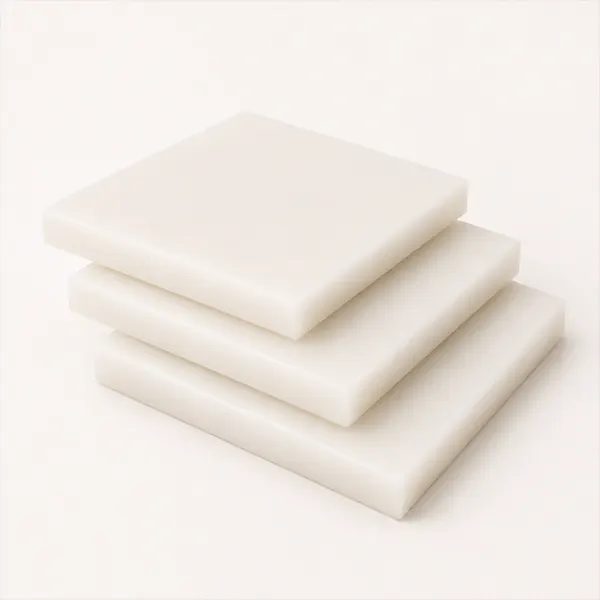
Overview
Polyethylene covers a family of related materials with significantly different properties depending on molecular weight and density. For engineering applications, the two most relevant grades are HDPE (High Density Polyethylene) and UHMW-PE (Ultra High Molecular Weight Polyethylene). HDPE is rigid, chemically resistant, and widely used for tanks, cutting boards, and structural sheet. UHMW-PE has an exceptionally high molecular weight, giving it outstanding abrasion resistance, a self-lubricating surface, and excellent toughness — including at low temperatures — making it the material of choice for wear liners, chute linings, conveyor wear strips, and marine fenders. Both have excellent chemical resistance and very low surface energy, which means they do not bond well with standard adhesives and cannot be painted without surface pre-treatment. Advance Supplies carries HDPE and UHMW sheet, rod, and tube.
Working properties
-
UHMW abrasion and wear resistance
UHMW-PE has outstanding abrasion resistance — among the best of any thermoplastic. Its self-lubricating surface reduces friction against metals and other materials, making it the default choice for wear liners, guide rails, and sliding contact surfaces where wear life is the primary requirement.
-
HDPE rigidity and structural use
HDPE is stiffer than UHMW and better suited for structural sheet applications — tanks, trays, machine bases, and fabricated enclosures. It machines cleanly and holds shape well under moderate mechanical load at ambient temperatures.
-
Chemical resistance
Both HDPE and UHMW-PE resist a very broad range of chemicals — including concentrated acids, alkalis, and aqueous solutions. Neither grade is suitable for aromatic or chlorinated solvents. Overall chemical resistance is excellent for most industrial and food-adjacent environments.
-
Impact resistance
UHMW-PE has exceptional impact toughness — it does not shatter under impact even at sub-zero temperatures. This makes it suitable for applications where brittle failure would be dangerous or costly, such as marine fenders, dock bumpers, and impact wear pads.
-
Low surface energy
Both grades have very low surface energy. This means they are naturally non-stick (useful in chutes and hoppers where materials tend to build up), but they do not bond well with standard adhesives. Mechanical fixing, welding, or flame/corona pre-treatment is required if bonding is necessary.
-
Colour and UV stability
Natural PE is white. Black grades contain carbon black which provides UV stability for outdoor use. For outdoor structural or wear applications, specify black grade. White/natural grades are commonly used in food-adjacent applications — confirm the specific grade requirements with your supplier.
Typical uses
- UHMW wear liners and chute linings in bulk handling and mining equipment
- UHMW conveyor wear strips, guide rails, and sliding pads
- UHMW marine fenders, dock bumpers, and offshore wear pads
- HDPE chemical storage tanks and process trays
- HDPE cutting boards and food preparation surfaces (confirm grade)
- HDPE structural sheet for outdoor enclosures and agricultural equipment
Things to confirm before ordering
- Grade — HDPE or UHMW: the properties are very different; confirm which is appropriate for your application before ordering.
- Colour — natural (white) or black (UV-stabilised for outdoor use); for food contact applications confirm the appropriate grade.
- Thickness and section — UHMW is available in thick wear-liner sections; HDPE in standard sheet thicknesses. Confirm what is in stock or available.
- Bonding and fixing — if you need to bond the material, discuss fixing method; standard adhesives do not work without surface treatment.
- UHMW vs standard PE for wear — if abrasion resistance is the priority, confirm UHMW is specified; standard HDPE has significantly lower wear resistance.
How does Polyethylene compare?
-
Nylon (PA) →
Nylon has higher strength and stiffness than UHMW-PE and is better for load-bearing sliding components like gears and structural bushings. UHMW-PE has better abrasion resistance, lower friction, no moisture absorption, and better impact at low temperatures.
-
Acetal / POM →
Acetal is stiffer, stronger, and more dimensionally stable than PE, making it better for precision machined parts. UHMW-PE has superior toughness, abrasion resistance, and chemical resistance.
-
Polypropylene (PP) →
PP is lighter and has better chemical resistance to organic solvents. HDPE is tougher and more commonly used for structural sheet and tank fabrication. For wear applications, UHMW-PE has no close PP equivalent.
Properties on this page are indicative only — exact mechanical, thermal, and chemical values vary by grade, filler, and manufacturer. Always verify suitability for your specific application before ordering. Need a certified grade? (FDA, UL94, food-grade, medical-grade, ISO) — ask us via WhatsApp and we will advise on what is available.