
Graphite
Isostatic Pressed Graphite
A self-lubricating, high-temperature carbon material used for seals, bearings, and electrodes in demanding process applications.
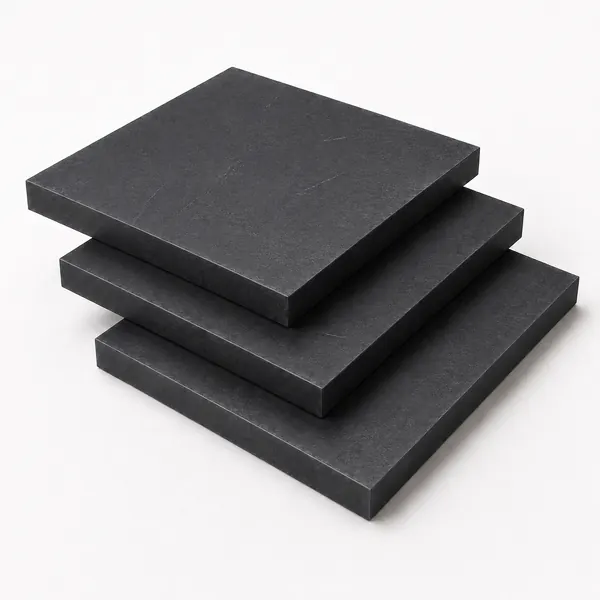
Overview
Engineering graphite — specifically isostatically pressed graphite — is a fine-grained carbon material used in applications where its unique combination of properties is required: high-temperature stability (it does not melt), self-lubrication, chemical inertness in most environments, and electrical conductivity. Graphite should not be confused with graphite-filled polymer composites; it is essentially pure carbon. It is machined to precise dimensions for mechanical seals, pump and compressor bushings, sliding electrical contacts, EDM electrodes, and high-temperature fixture work. It is brittle and relatively fragile — careful handling is required.
Working properties
-
High-temperature stability
Graphite does not melt — it sublimes (transitions directly from solid to gas) at extremely high temperatures. This makes it one of the only solid materials that can be used in very high temperature applications in non-oxidising or inert atmospheres. In air at elevated temperatures it will oxidise; for very high-temperature air service, impregnated or coated grades are used.
-
Self-lubrication
Graphite has excellent self-lubricating properties due to the layered structure of its carbon lattice. This makes it suitable for dry-running bearing, bushing, and seal applications where liquid lubrication is impractical or undesirable — particularly at elevated temperatures.
-
Chemical resistance
Graphite is resistant to a very wide range of acids, bases, solvents, and chemicals. It is generally more chemically inert than most engineering plastics at elevated temperatures. It is attacked by strong oxidising acids at elevated temperatures and should not be used in those environments without expert verification.
-
Electrical conductivity
Graphite is electrically conductive — unlike polymer insulators. This is essential for EDM electrode applications and sliding electrical contacts, and is also a consideration in applications where electrical isolation is required (graphite is not an insulator).
-
Brittleness and fragility
Engineering graphite is brittle and has low tensile strength. It fractures rather than deforming under impact or shock. Components must be handled carefully during machining and assembly, and mounting designs should not rely on tensile loads.
-
Machinability
Graphite machines well and can be shaped to precise dimensions using carbide or diamond tooling. It produces significant fine carbon dust during machining — respiratory protection and appropriate dust extraction are essential.
Typical uses
- Mechanical seal faces for pumps in chemical process service
- Dry-running bushings and bearings in high-temperature or vacuum applications
- EDM (electrical discharge machining) electrodes
- Sliding electrical contacts and brushes for motors and generators
- High-temperature fixtures and setters for sintering and heat treatment
- Carbon vanes for rotary vane pumps and compressors
Things to confirm before ordering
- Grade — fine-grain isostatic grades have better strength and machinability than extruded grades; confirm the appropriate grade for your application.
- Impregnation — graphite can be resin-impregnated to seal porosity and improve performance in liquid service; specify if impregnation is required.
- Oxidising environment — confirm whether the service atmosphere contains oxygen at elevated temperatures; oxidation protection may be needed.
- Section size — graphite is available in block, rod, and plate; confirm the required dimensions and whether they can be supplied from stock or require production.
How does Graphite compare?
-
Carbon-filled PTFE
Carbon-filled PTFE is a polymer composite — softer, more conformable, and easier to handle than solid graphite. It is used for seal faces and bearings at lower temperatures. Solid graphite is required for higher temperatures and more demanding chemical environments.
-
Silicon Carbide (SiC)
SiC is harder and more wear-resistant than graphite and is the typical counter-face material in mechanical seals. SiC is not self-lubricating; graphite is often paired against SiC in seal face pairs precisely for this reason.
Properties on this page are indicative only — exact mechanical, thermal, and chemical values vary by grade, filler, and manufacturer. Always verify suitability for your specific application before ordering. Need a certified grade? (FDA, UL94, food-grade, medical-grade, ISO) — ask us via WhatsApp and we will advise on what is available.