
EVA
Ethylene Vinyl Acetate
A soft, flexible, closed-cell foam or solid sheet used for cushioning, padding, and insole applications.
Overview
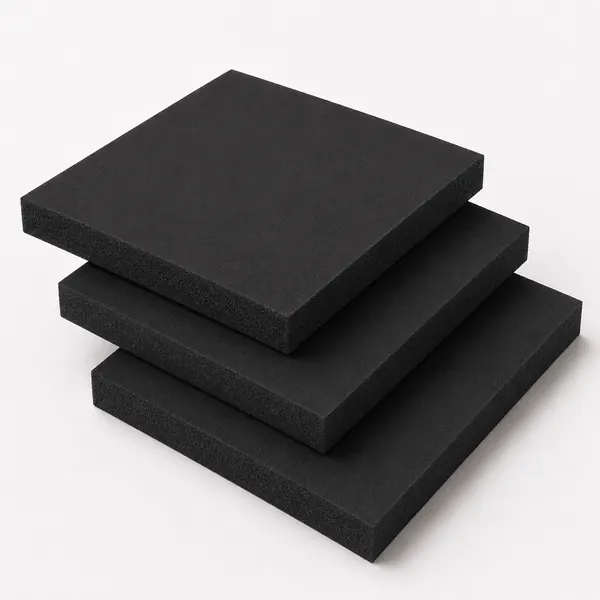
EVA (Ethylene Vinyl Acetate) is a flexible thermoplastic with rubber-like softness that is commonly processed in foam (closed-cell expanded) form. It is widely recognised in footwear soles, foam matting, and sports equipment padding. EVA foam provides good impact cushioning, buoyancy, and resistance to cracking at low temperatures. It is lightweight, easy to cut and shape, and resistant to UV and seawater. Solid EVA sheet is used for gaskets and sealing in less demanding environments. EVA is not an elastomeric rubber in the engineering sense — it cannot be vulcanised — but it functions as a rubber-like material for cushioning and flexible sealing applications.
Working properties
-
Cushioning and impact absorption
EVA foam provides excellent cushioning and shock absorption at low weight. It is the dominant material in footwear midsoles and protective padding because it compresses and recovers well under repeated impact.
-
Buoyancy
Closed-cell EVA foam is buoyant and water-resistant, making it widely used in marine and watersport applications — life jacket cores, boat cushions, floating mat surfaces, and dock fenders.
-
Low-temperature flexibility
EVA remains flexible at low temperatures where many rubbers would stiffen. It is used in refrigerated environments and cold-climate cushioning applications.
-
UV and weather resistance
EVA foam resists UV degradation and is suitable for outdoor and marine applications where sunlight exposure is ongoing.
-
Chemical resistance
EVA is resistant to water, dilute acids, and alkalis, but not to petroleum-based solvents or oils. For solvent or oil contact, other materials are required.
-
Processing
EVA foam sheet can be cut with knives, scissors, die cutters, or laser cutters into complex profiles. It can be bonded with contact adhesives and thermoformed at moderate temperatures.
Typical uses
- Footwear soles, insoles, and midsoles
- Cushioning mats, anti-fatigue flooring, and gym flooring
- Marine and watersport cushioning — kayak seats, boat mats, dock edging
- Protective packaging inserts and carrying case foam
- Gaskets and sealing in low-pressure, non-oil applications
- Life jacket and buoyancy aid foam cores
Things to confirm before ordering
- Foam density — EVA foam density varies significantly; lower density for cushioning, higher density for structural foam applications. Confirm density requirement.
- Hardness or firmness — firmness relates to both density and vinyl acetate content; confirm the required feel for the application.
- Thickness — foam sheet is available in a range of thicknesses; confirm the required thickness.
- Colour — EVA foam is available in a range of colours; confirm if colour is relevant.
How does EVA compare?
-
PU foam
PU foam can be formulated for softer or more memory-foam behaviour and is used in furniture and bedding. EVA foam is more buoyant, more UV-stable, and more commonly used in footwear and marine applications.
-
Silicone foam
Silicone foam handles far higher temperatures and is used in industrial gaskets and seals. EVA is suitable for ambient-temperature cushioning applications at a much lower cost.
Properties on this page are indicative only — exact mechanical, thermal, and chemical values vary by grade, filler, and manufacturer. Always verify suitability for your specific application before ordering. Need a certified grade? (FDA, UL94, food-grade, medical-grade, ISO) — ask us via WhatsApp and we will advise on what is available.