
ESD UHMW
Electrostatic Dissipative Ultra-High Molecular Weight Polyethylene
The chemical inertness and abrasion resistance of UHMW-PE, modified for static-dissipative performance in ESD-sensitive environments.
Overview
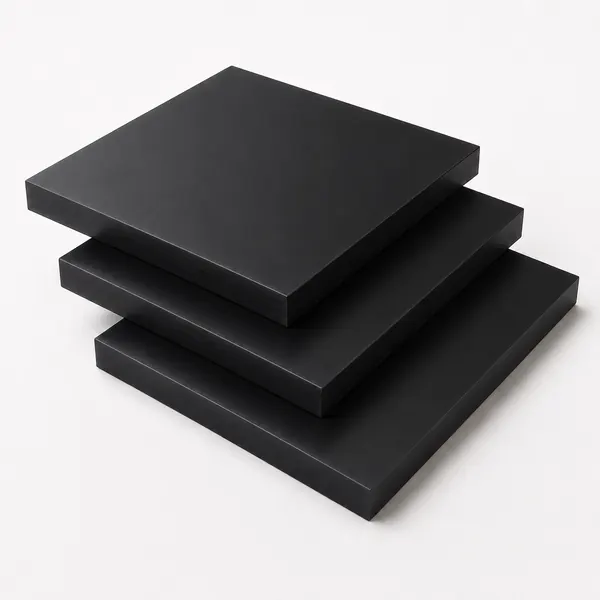
ESD UHMW is a carbon-loaded or otherwise modified grade of Ultra-High Molecular Weight Polyethylene (UHMW-PE) that provides electrostatic dissipative properties while retaining the material's characteristic low friction, high abrasion resistance, and chemical inertness. Standard UHMW is an insulating material, which can accumulate and suddenly discharge static — a risk in electronics manufacturing and semiconductor handling. ESD UHMW addresses this by providing a controlled path for static charge dissipation, making it appropriate for guides, rails, fixtures, and sliding components in ESD-controlled environments where the mechanical properties of UHMW are required.
Working properties
-
Static dissipative behaviour
ESD UHMW provides a controlled surface and volume resistivity that allows static charge to dissipate safely rather than accumulating and discharging suddenly. The specific resistivity range should be confirmed for your ESD control classification and application requirements.
-
Abrasion resistance
Like standard UHMW-PE, ESD grades retain excellent abrasion resistance — among the highest of any engineering plastic. This makes ESD UHMW particularly valuable in conveyor guide rails, wear strips, and sliding contact applications in ESD-controlled environments.
-
Low friction
ESD UHMW maintains the self-lubricating, low-friction surface characteristic of UHMW-PE. Sliding components, guide rails, and chutes benefit from reduced friction and wear without lubrication.
-
Chemical resistance
ESD UHMW retains the broad chemical resistance of standard UHMW-PE, resisting most acids, bases, solvents, and cleaning agents used in industrial and electronics manufacturing environments.
-
Machinability
ESD UHMW is workable but requires sharp tooling and appropriate feed rates. The material tends to be soft and can flex during machining; securing the workpiece properly is important for dimensional accuracy.
Typical uses
- Conveyor guide rails and wear strips in semiconductor and electronics manufacturing
- ESD-safe sliding fixtures, trays, and component handling guides
- Cleanroom equipment components requiring low particle generation and static control
- Wear liners and guides in automated handling equipment in ESD-controlled areas
Things to confirm before ordering
- Resistivity class — confirm the required surface and volume resistivity range for your ESD classification (typically static dissipative 10⁵–10¹¹ Ω or conductive below 10⁵ Ω); not all ESD UHMW grades meet every class.
- Colour — ESD UHMW is typically black due to carbon loading; confirm if colour matters.
- Application type — surface resistivity matters for dissipation path; volume resistivity matters for bulk components; confirm which governs your application.
- Certifications — if traceable ESD compliance documentation is required, specify at the time of enquiry.
How does ESD UHMW compare?
-
Standard UHMW-PE →
Standard UHMW-PE is insulating and unsuitable for ESD-controlled environments. If your application requires low friction and abrasion resistance but does not have ESD requirements, standard UHMW-PE is the appropriate and more economical choice.
-
ESD POM (Acetal) →
ESD POM is dimensionally more precise and stiffer than ESD UHMW, better for machined precision components. ESD UHMW is the choice where abrasion resistance and low friction on wear surfaces are the primary requirements.
Properties on this page are indicative only — exact mechanical, thermal, and chemical values vary by grade, filler, and manufacturer. Always verify suitability for your specific application before ordering. Need a certified grade? (FDA, UL94, food-grade, medical-grade, ISO) — ask us via WhatsApp and we will advise on what is available.