
ABS
Acrylonitrile Butadiene Styrene
A tough, dimensionally stable thermoplastic widely used for housings, enclosures, and light structural components.
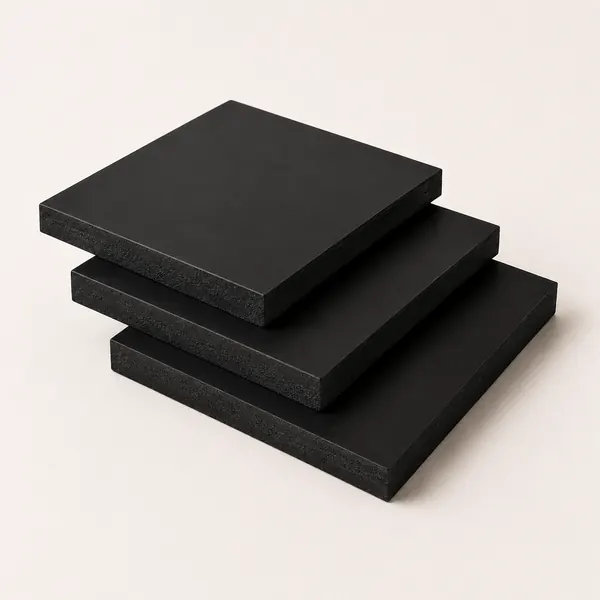
Overview
ABS (Acrylonitrile Butadiene Styrene) is one of the most widely used engineering thermoplastics. It combines good impact resistance, dimensional stability, and a hard, attractive surface finish that accepts paint and adhesives well. ABS is an amorphous material that is easy to machine and fabricate, and it is commonly injection-moulded in the mass-production world, but it is also available in sheet and rod form for machined and fabricated components. It is used across automotive, consumer goods, electronics, and general industrial applications. It is not intended for extended high-temperature environments or continuous chemical contact.
Working properties
-
Impact resistance
ABS provides good impact resistance across a range of temperatures, including moderate cold. The butadiene rubber phase within the polymer absorbs energy, making ABS tougher than general-purpose polystyrene or HIPS without reaching the level of polycarbonate.
-
Machinability
ABS machines cleanly and produces a good surface finish. It saws, drills, mills, and turns without chipping and responds well to CNC routing. Standard tooling used for other thermoplastics is appropriate.
-
Surface finish and bondability
ABS has a hard, smooth, low-sheen surface that accepts paint and adhesives well. It bonds readily with ABS cement and many structural adhesives. It can be hot-gas welded using ABS welding rod.
-
Dimensional stability
ABS is dimensionally stable under moderate temperature and load. It is an amorphous polymer with predictable machining behaviour and low warpage compared with semi-crystalline grades such as nylon or acetal.
-
Temperature limitations
ABS softens at relatively modest temperatures compared with engineering plastics like nylon or acetal. It is not suitable for continuous high-temperature service, near heat sources, or autoclaving.
-
Chemical resistance
ABS has moderate chemical resistance. It is resistant to dilute acids and alkalis, water, and many oils, but is susceptible to concentrated acids, ketones, esters, and aromatic hydrocarbons. Confirm compatibility for any chemical-contact application.
Typical uses
- Housings, enclosures, and covers for equipment and instruments
- Interior panels, brackets, and structural components
- Machined fixtures, jigs, and prototype parts
- Automotive interior trim and components
- Consumer goods and appliance components
Things to confirm before ordering
- Grade — standard, flame-retardant, or other modified grade; confirm which is appropriate for your application.
- Colour — natural ABS is an off-white or cream colour; black and other colours are available. Confirm availability for your required colour.
- UV exposure — standard ABS yellows under UV; for outdoor or UV-exposed applications, confirm whether UV-stabilised or ASA (UV-stable ABS alternative) is more appropriate.
- Chemical contact — confirm compatibility with any chemicals, fluids, or cleaning agents the part will be exposed to.
How does ABS compare?
-
HIPS →
HIPS is cheaper but less tough, less chemically resistant, and has a softer surface. ABS is the better engineering choice for any application requiring durability. HIPS is appropriate for light display and interior use only.
-
Polycarbonate (PC) →
PC provides far superior impact resistance and is appropriate for safety-critical applications. ABS is easier to machine and bond, and is typically less expensive. PC/ABS alloy blends are available when a combination of both properties is needed.
Properties on this page are indicative only — exact mechanical, thermal, and chemical values vary by grade, filler, and manufacturer. Always verify suitability for your specific application before ordering. Need a certified grade? (FDA, UL94, food-grade, medical-grade, ISO) — ask us via WhatsApp and we will advise on what is available.